Crystal stickers have become a practical option for businesses producing customized gifts, branded packaging, promotional merchandise, and decorative products. Their glossy appearance, raised texture, and ability to transfer designs onto many hard surfaces make them attractive for both small-batch customization and commercial production. A UV DTF transfer printer simplifies this process by combining digital printing, UV curing, and film-based transfer into a workflow that reduces the need to print directly on each finished object.
Understanding UV DTF Crystal Sticker Printing
UV DTF printing creates decorative transfers on film rather than requiring the printer to accommodate every finished product. The design is printed onto A film using UV inks, after which B film is laminated over the printed design. Once the transfer is prepared and cut, it can be applied to a compatible surface and transferred by pressing it firmly into place.
This approach offers flexibility for businesses handling products with different shapes, sizes, and surface characteristics. Instead of repositioning a bulky bottle, curved gift box, or irregular promotional item inside a printer, operators can prepare the design on film and apply it separately. This simplifies production planning and makes personalized orders easier to manage.
How a UV DTF Transfer Printer Streamlines Production
Traditional direct printing can require product-specific fixtures, careful positioning, and repeated machine adjustments. A UV DTF transfer printer shifts much of the printing work to a standardized film workflow. Operators can print multiple designs on a roll or sheet, laminate the transfers, cut individual stickers, and apply them when the products are ready.
The separation between printing and application also supports batch production. A workshop can prepare transfers in advance, store them appropriately, and apply them as orders arrive. For businesses serving multiple customers, this can reduce repeated setup work and help coordinate different product lines without changing the basic printing process.
Automation further improves consistency. Integrated printing and laminating functions reduce manual handling between stages, while controlled printhead movement helps maintain alignment and detail. UV curing solidifies the printed ink layers during production, supporting a finished design with defined edges and a glossy appearance.
Expanding Substrate Options for Custom Products
One major advantage of crystal stickers is their versatility across compatible hard surfaces. Glass drinkware, metal accessories, acrylic displays, plastic containers, and selected wooden products can all become candidates for branded decoration. This gives promotional merchandise suppliers and gift manufacturers more options without requiring a separate direct-printing setup for every substrate.
Glass products benefit from the transparent transfer film and detailed graphics, making the process suitable for decorative bottles, jars, and selected drinkware. Metal items such as keychains, promotional accessories, and gift tins can carry logos or personalized artwork. Acrylic signs and plastic product housings offer additional opportunities for decorative labels and product identification.
However, substrate compatibility should not be treated as universal. Surface coatings, texture, curvature, cleanliness, and the specific adhesive system affect transfer results. Smooth, clean surfaces generally provide a better starting point than dusty, oily, or heavily textured materials. Businesses should test adhesion and durability on the actual product before accepting large orders, especially when items will experience frequent handling or washing.
Choosing Equipment for Consistent Crystal Sticker Quality
Equipment selection affects production capacity, print detail, and the time required to complete each order. When evaluating a UV DTF printer manufacturer, commercial buyers should consider printhead configuration, printing width, rated speed, curing performance, laminating integration, and maintenance requirements. The best choice depends on the expected order volume, artwork complexity, available workspace, and range of products served.
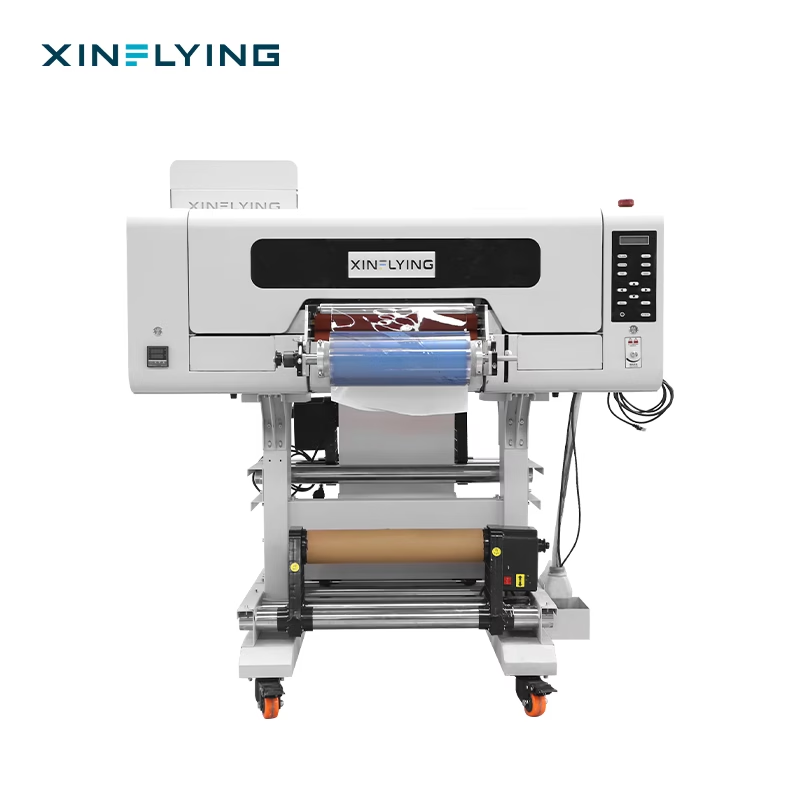
Xinflying’s XF-450S UV DTF printer is designed for crystal label production. Its official specifications list three Epson i1600-U1 printheads, a 12-inch printing width, and a printing speed of 2.75 m²/h at 8-pass mode. It supports A+B UV PET film, with a machine size of 1,300 × 1,000 × 1,450 mm.
The model also integrates printing and laminating, uses air-cooled UV curing lamps, and includes printhead anti-collision protection and a low-ink alarm. These features can help businesses organize production and monitor routine operations. Buyers comparing equipment from a UV DTF printer manufacturer should confirm actual output requirements and consumable compatibility before purchasing.
Improving Workflow from Design to Application
A reliable workflow begins with correctly prepared artwork and suitable print settings. Operators then print the design on A film, laminate it with B film, cut the transfer to size, and apply it to the target object. Before application, the surface should be clean and dry. Firm, even pressure helps the adhesive contact the substrate, while careful film removal reduces the risk of lifting the design.
Quality checks should cover color consistency, fine details, lamination, transfer alignment, and adhesion. Sample testing is particularly important for products with coatings or curved surfaces. Businesses should also assess resistance to routine handling under the conditions expected for the finished product rather than assuming every transfer will perform identically.
For production teams, recording successful settings by substrate and film combination can reduce repeated experimentation. This process supports more predictable output when handling repeat orders or multiple product categories.
Making Crystal Sticker Production More Scalable
Crystal stickers give printing businesses a flexible way to add value to drinkware, packaging, promotional gifts, and decorative accessories. A well-selected UV DTF transfer printer can simplify customization by separating printing from product application, while integrated functions and appropriate operating procedures help maintain workflow consistency.
For businesses comparing a UV DTF printer manufacturer, the decision should balance verified specifications, substrate testing, production volume, and after-sales support. With its XF-450S model and broader digital printing solutions, Xinflying offers an option for businesses seeking to develop UV transfer production around varied customer requirements. Careful equipment selection and process control remain essential to delivering consistent, professional results.
