A silicone component can have an approved CAD model and still be unready for production. The missing information is often not another drawing dimension, but a clear connection between geometry, material, tooling, inspection, and the component’s actual function. That gap becomes expensive once a mold has been manufactured.
For buyers and engineers, the better question is whether the project has enough definition to support a repeatable manufacturing process. Silicone compression molding should be assessed from that perspective: what is known, what remains uncertain, and which decisions need to be settled before production tooling is committed.
The Drawing Is the First Manufacturing Decision
A 3D model describes shape, but it does not necessarily explain manufacturing priorities. Silicone parts frequently contain sealing lips, grooves, flexible walls, buttons, diaphragms, or protective features whose functional importance differs considerably from their appearance.
Critical features should therefore be identified before the mold design begins. A sealing interface may require tighter dimensional control than an external contour. A flexible membrane may depend more on consistent thickness than on a cosmetic surface. HordRT reviews geometry together with application requirements so that tooling decisions are connected to what the finished component must actually do.
Tolerance notation also deserves scrutiny. Silicone is an elastomer, so dimensions can be affected by material behavior, geometry, hardness, shrinkage, and the feature being measured. HordRT’s design guidance recommends identifying critical dimensions on the drawing for engineering review rather than assuming one tolerance scheme is appropriate for every feature.
Tooling Should Resolve Ambiguity, Not Create It
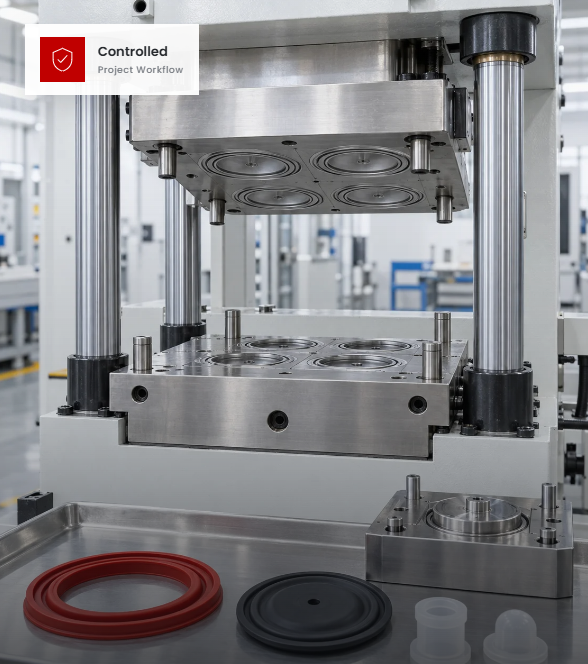
Once the part requirements are understood, the mold becomes a physical interpretation of those requirements. Parting-line placement, cavity configuration, flash-control strategy, venting, and demolding all need to support the intended component rather than simply reproduce its CAD geometry.
Parting lines deserve particular attention on silicone components. Flash can occur where mold surfaces meet, so locating that interface on a critical sealing or cosmetic area can create avoidable finishing or functional concerns. HordRT’s published design guidance recommends considering appearance, sealing surfaces, trimming access, and functional contact areas when determining the parting line.
Undercuts require a similarly deliberate assessment. Silicone’s flexibility can permit some geometries to be removed from a mold without the mechanical actions that might be required for rigid plastics. That does not mean every undercut is automatically manufacturable. Depth, local wall thickness, surface texture, and release direction still determine whether demolding can occur without damaging the component.
Material Selection Changes the Manufacturing Plan
Material selection should not be reduced to choosing a Shore hardness. The compound has to match the component’s operating environment and functional demands, while its processing characteristics must remain compatible with the planned molding method.
HordRT describes material selection around factors such as flexibility, sealing performance, temperature exposure, operating environment, color, and hardness. Its current silicone service information also notes that application-specific material directions can be reviewed for projects involving requirements such as food contact or medical use, with documentation and testing requirements confirmed during project review.
The distinction between HCR and LSR can also change the process discussion. HCR is a solid silicone compound commonly prepared as a measured charge for compression molding, whereas LSR is processed as a liquid two-component material through an injection system. Treating the two materials as interchangeable can lead to an unsuitable tooling or equipment decision.
Inspection Should Be Designed Before the First Shot
Quality control becomes much clearer when inspection requirements are defined before production rather than after a problem appears. A drawing should distinguish dimensions that affect assembly or performance from characteristics that are primarily descriptive.
A sensible inspection plan can include dimensional verification, visual and surface examination, and material or hardness checks where those characteristics are specified. HordRT states that inspection requirements are matched to the drawing, application, and agreed quality plan, with inspection documentation available according to project requirements.
Sampling then becomes a decision point rather than a formality. Initial parts can reveal whether flash appears in an acceptable location, whether flexible features release cleanly, and whether critical dimensions behave as expected. Any necessary tooling adjustment is generally easier to address at this stage than after repeat production has begun.
Production Readiness Depends on More Than a Good Sample
A successful first article demonstrates that a particular part can be produced. It does not automatically prove that the entire manufacturing strategy is ready for sustained orders.
Production planning should connect expected quantity with cavity configuration, material availability, finishing requirements, inspection effort, and tooling strategy. HordRT supports silicone molding projects across different production stages, allowing manufacturers to move from initial sampling to bridge production and repeat orders without being constrained by a minimum order quantity.
This flexibility helps align tooling and production decisions with actual project demand, reducing unnecessary inventory commitments while maintaining a practical path toward repeat manufacturing.
That flexibility is useful when the production path is still being validated. A project can move from design review to tooling, sampling, and subsequent production without treating each stage as an isolated sourcing exercise.
A practical readiness check can therefore be framed as a simple chain: functional requirement → manufacturable geometry → suitable material → appropriate tooling → measurable acceptance criteria. If any link remains undefined, the project carries uncertainty into the next stage.
For purchasing teams, that perspective changes the RFQ conversation. Instead of requesting a mold price from a finished CAD file alone, they can provide the application, critical dimensions, material expectations, quantity, inspection requirements, and relevant documentation needs. Engineers can then evaluate the complete manufacturing route before tooling is locked in.
A production-ready silicone project is not necessarily the one with the most detailed drawing. It is the one in which the important decisions have already been connected. That preparation gives the molding supplier a clearer engineering target and gives the buyer a more defensible basis for approving tooling and moving toward repeat production.
