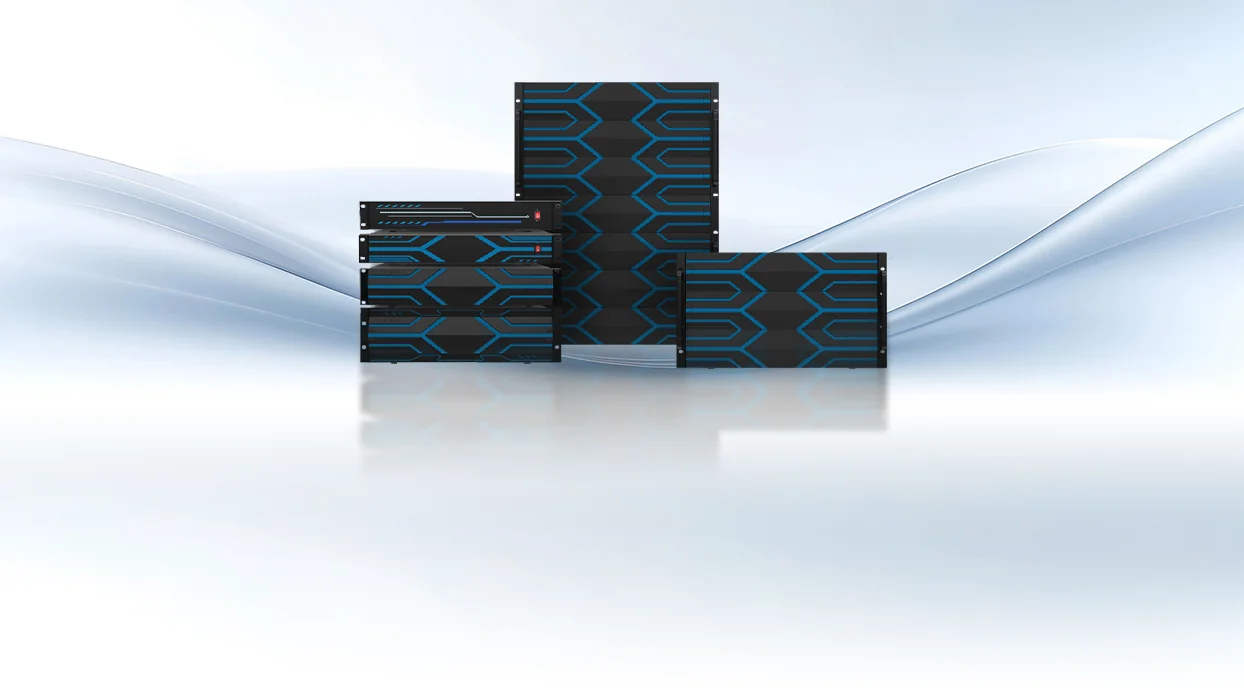
Two processors may both accept 4K signals and still belong in very different system designs. One may route finished video to conventional display outputs, while another may combine composition with direct control of an LED network. A useful comparison of LED video wall processors therefore begins with the work assigned to the device, then moves to connector counts and headline resolutions.
Four resources define most practical limits: acquisition capacity, output topology, simultaneous layer capacity, and total pixel responsibility. They interact, but none can substitute for another. Forty inputs do not guarantee forty visible windows, and a large LED load does not prove that enough independent sources can be composed at once.
Begin with Architecture and Signal Ownership
Architecture determines where processing ends and where LED control begins. A professional splicing platform generally accepts sources, scales or arranges them, and produces standard video outputs for downstream equipment. An all-in-one platform may add the sending stage, converting the finished canvas into Ethernet or fiber paths for receiving cards.
LED video wall processors should first be classified by this boundary because it changes cabling, redundancy, troubleshooting, and the number of devices in the rack. Pure-hardware FPGA processing is relevant when deterministic routing and continuous operation are priorities.
Even then, the project drawing must identify every source, processed canvas, output group, and LED endpoint. A device that integrates more functions can simplify the chain, but only if its integrated outputs match the installed control system.
Separate Input Scale from Output Scale
Input capacity describes how many signals and formats can enter the chassis; output capacity describes how many independent rasters can leave. LED video wall processors may support HDMI, DisplayPort, DVI, SDI, IP, or HDBaseT through different cards, and the installed card population matters more than the number of empty slots.
Source resolution and refresh rate must also be counted, since one 8K feed represents a different acquisition burden from several 1080p feeds. Published maxima should be converted into a populated configuration before comparison.
Card placement, connector mode, shared resources, and simultaneous operation can determine whether several headline capacities are available together or only under separate conditions. The comparison is valid only when every quoted limit belongs to the same proposed chassis and card population.
On the output side, a 4K connector can carry a large raster, but multiple outputs may be required for an ultra-wide canvas, separate walls, or redundant routes. Kystar’s SEn family scales to as many as 32 4K@60Hz outputs or 128 2K routes. The stated output count indicates routing potential rather than a guaranteed project configuration; actual capacity still depends on the selected chassis, populated cards, and operating mode.
Bidirectional planning is equally useful. Starting at each destination exposes how many unique rasters are needed, while starting at each source exposes duplication and conversion requirements. The two counts often differ, especially when one source appears on several walls or a single canvas spans several connectors.
Count Layers at the Intended Resolution
A layer is a visible source window or graphic plane in the composition, not merely an available input. The layer budget becomes critical when dashboards, cameras, presentations, remote feeds, and backgrounds must remain on screen together.
The correct comparison asks how many layers are available at the required resolution and whether layer sharing or other model-specific rules apply. A chassis with large connector counts can still become constrained if the scene requires more simultaneous windows than the processing structure supports.
SEn systems can provide as many as 192 layers in one device. The LED video wall processors in the SHn line from Kystar reach up to 128 2K layers depending on model while combining switching, splicing, and LED control. These are different system roles, so the larger number is not automatically the better choice.
Translate Pixel Capacity into a Physical Canvas
Pixel capacity becomes meaningful only after the wall raster is calculated. Cabinet width and height in pixels are multiplied by cabinet counts, then divided among output paths. LED video wall processors that drive standard video outputs are usually evaluated by output rasters and channel count; processors with integrated LED sending must also be checked against Ethernet-port quantity and the total load assigned to those ports.
The SHn family spans SH2, SH3, SH8, and SH14. Its largest configuration supports up to 224 Ethernet ports and approximately 147.2 million pixels of LED load. It can also accept up to 40 simultaneous 4K@60Hz inputs. Those maxima describe different subsystems and should be recorded separately rather than merged into one vague capacity rating.
Compare Operational Controls after Capacity Fits
Once the signal math works, daily operation becomes the differentiator. Web control, centralized management, monitoring, preview, saved scenes, and backup behavior affect commissioning and recovery. Support for 8K processing, RGB 4:4:4, flexible windowing, and 3D formats may be shared across product lines, yet their value depends on the actual program material and control workflow.
LED video wall processors need an acceptance test that includes the heaviest approved scene, a source change, a saved-scene recall, and a recovery event. The final comparison should read like a system schedule: architecture, populated input cards, active source formats, output interfaces, canvas ownership, simultaneous layers, LED load where applicable, and operating controls.
That record makes SEn and SHn comparable without pretending that they perform identical jobs. Capacity then supports a defined display design instead of becoming a collection of unrelated maximum numbers.
