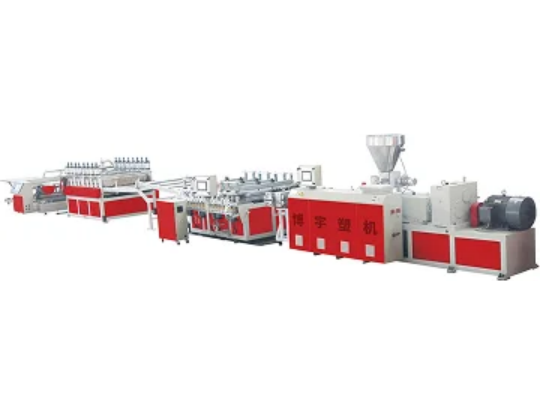
In the production of Wood Plastic Composite (WPC) flooring, the consistency of the final product begins long before the material enters the extruder. Because WPC formulations combine high-density PVC with organic wood flour—materials with vastly different bulk densities and flow characteristics—the feeding hopper serves as a critical interface. An optimized feeding system in a WPC flooring production line prevents common industrial hurdles such as material “bridging,” where wood fibers entangle and block the flow, or “ratholing,” which leads to inconsistent dosing and structural weak points in the flooring core.
The Physics of Uniform Material Dosing
To achieve a high-quality WPC board, the raw material must maintain a precise ratio, often involving 30% to 60% wood flour. Traditional gravity hoppers often struggle with these mixtures because wood flour is hygroscopic and prone to static accumulation. Advanced systems utilize “force feeding” mechanisms or twin-screw volumetric feeders to ensure a positive displacement of the material into the barrel.
Effective hopper design also incorporates vertical or horizontal agitators. These internal stirring arms break up fiber clusters and ensure that the PVC resin, stabilizers, and wood particles remain a homogeneous dry blend. For a WPC flooring extrusion machine to operate at a steady output of 400kg/h to 800kg/h, the feeding pressure must remain constant. Fluctuations at the hopper stage result in “surging” at the die head, which compromises the dimensional accuracy and density of the foamed WPC layers.
Industrial Feeding Excellence by Boyu
For B2B manufacturing plants where uptime is the primary KPI, Boyu provides highly engineered feeding solutions integrated directly into their WPC flooring production line. Their systems are designed to handle the complex rheology of wood-plastic blends, featuring stainless steel hoppers with specialized internal geometries that promote mass flow.
By utilizing high-torque dosing motors and precision sensors, they ensure that their WPC flooring extrusion machine receives a perfectly metered stream of raw material. Their technical configurations, such as the SZJZ series conical twin-screw extruders, are often paired with vacuum-assisted feeding systems to remove residual moisture and air, preventing porosity in the finished plank. Their commitment to mechanical precision allows B2B clients to maintain high-speed production while reducing material waste. Through these robust engineering choices, they help their partners achieve the strict tolerances required for premium commercial-grade WPC flooring.
