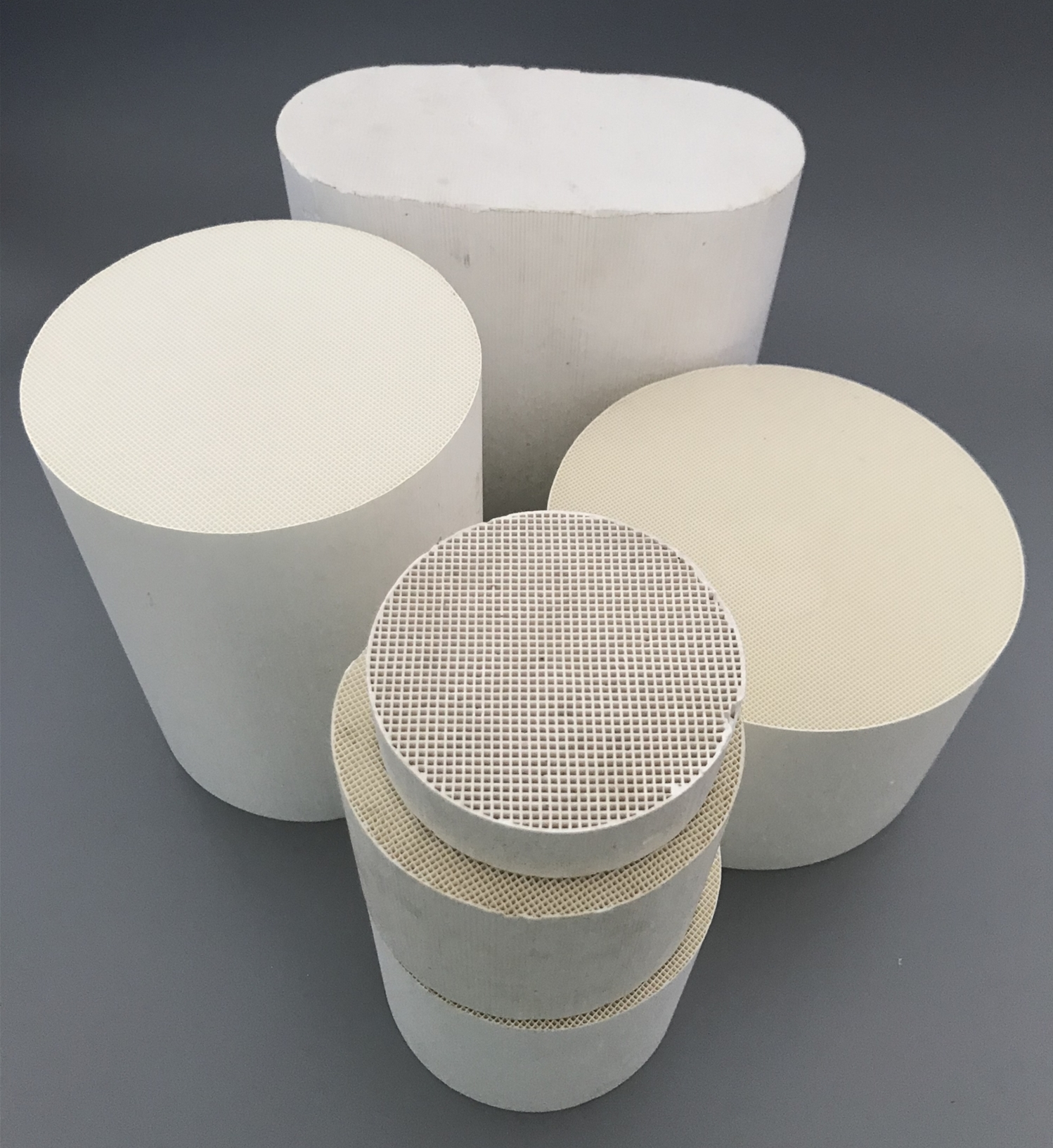
The phrase ceramic honeycomb filter can hide two different questions: what a support looks like and what the supported catalyst actually does. In diesel exhaust treatment, parallel ceramic channels can carry an oxidation coating. They allow gas to pass while the coating reacts with selected pollutants. A wall-flow particle filter blocks alternate channels to trap soot, a different mechanism.
Hydrogenation catalysis belongs to yet another operating setting. Feed materials and hydrogen contact an active system inside an industrial reactor; the support need not be an exhaust honeycomb. Treating every catalyst as a variation of one ceramic block overlooks changes in reactants, flow pattern, and mechanical loading. The proper comparison begins with the reaction and the path through the equipment.
Trace the Gas Path before Naming the Device
A flow-through diesel oxidation catalyst provides coated channel walls for reactions involving carbon monoxide, hydrocarbons, and soluble organic fractions. Oxygen and sufficient temperature are needed for those compounds to oxidize. The many channels give a large contact surface without forcing the entire exhaust stream through a porous wall. Such a monolith is not, by that description alone, a soot-trapping device.
An actual particulate filter uses a different channel arrangement. Alternately plugged passages send exhaust through porous walls, depositing particles that later require regeneration. A ceramic honeycomb filter search may lead to both types of products, but the drawing and gas path identify which one is proposed.
Open channels and wall-flow channels cannot be treated as equivalent merely because both use ceramic material. A channel drawing decides whether an oxidation or filtration test is relevant.
Measure Oxidation and Pressure Separately
Pressure behavior also differs. An open flow-through element has resistance associated with channel geometry, coating, and flow. A particle filter adds resistance as soot accumulates, then changes again during regeneration.
A comparison between the devices therefore needs separate measurements at specified loading states. The shared word “honeycomb” says nothing about which pressure curve belongs to the offered unit.
A ceramic honeycomb filter inquiry needs a pressure record tied to the channel drawing. For open passages, flow and coating define the resistance being measured. For alternately plugged channels, the recorded loading state during each measurement matters as well. Keeping those conditions beside each pressure result distinguishes a geometry effect from resistance caused by accumulated soot.
Oxidation measurements belong beside flow and temperature, because coating and exhaust composition set the reaction conditions. The ceramic honeycomb DOC at Hualian Catalyst offers customizable sizes and 200 to 600 CPSI, specifying oxidation of CO, HC, and soluble organic fractions. CPSI describes channel count per square inch; conversion measurements concern the coated unit under stated exhaust conditions.
For the DOC, dimensions and CPSI describe the passages; oxidation targets, flow, and temperature describe what happens along them. Loading-state pressure measurements answer a different question if the unit is a particle filter.
Hualian’s industrial hydrogenation product introduces a further change: active-metal system, alumina carrier, feed duty, reactor conditions, and product analysis replace the exhaust data set. Its process begins with feed entering a reactor.
Locate Reactants in the Industrial Reactor
In industrial hydrogenation catalysis, hydrogen participates directly in reactions with the process feed. A supported active metal must remain accessible to those reactants under the reactor’s temperature, pressure, and flow conditions. The support influences contact and mechanical survival, but the relevant arrangement is not dictated by an exhaust canister’s channel-count convention.
Hualian uses promoted alumina with nickel-based active components for its industrial hydrogenation product rather than a honeycomb monolith. The stated applications include aviation-kerosene dearomatization, benzene and phenol hydrogenation, crude-hexane hydrofining, white-oil and lube-oil hydrogenation, and liquid-phase desulfurization. These examples describe chemical-process duties, not functions of the ceramic DOC installed in a diesel exhaust line.
The feed determines which application data are useful. Dearomatization requires attention to the aromatic content before and after treatment; desulfurization examines sulfur removal under the specified process conditions. An oxidation converter’s CO result cannot predict either outcome. Even the meaning of “activity” changes when the measured reactant, product, and reactor differ.
Support form follows those requirements. A particulate carrier creates contact through many separate bodies and internal pore spaces, while a monolith presents ordered passages to a moving gas stream. Loading, particle integrity, and bed flow matter in the industrial reactor. Cell density matters in the exhaust honeycomb. Neither property substitutes for a reaction test on the proposed feed.
Evidence from one process can still inform a question without proving an answer for the other. Mechanical stability matters to both, but a diesel thermal cycle and an industrial reactor’s particle loading are different tests. Likewise, surface area can describe potential access in either setting only when the way reactants reach that area is clear.
Following the stream resolves the terminology: gas moves along a DOC’s coated channels, crosses a soot filter’s walls, or meets alumina-supported active material in a hydrogenation reactor.
CO, HC, and soluble-organic-fraction conversion are measured at the DOC’s exhaust flow and temperature. Hydrogenation catalysis is assessed through the named feed and product target. The support description identifies flow; measured chemical change identifies its reaction duty.
